
How a European Chemical Multinational Optimized Plant Thermal Ventilation in Brazil with Ansys Simulation
Discover how Criteq used CFD virtual prototyping to ensure thermal comfort for a European resin production line adapting to tropical climates, optimizing CAPEX in ventilation systems.


“Ansys simulation allowed us to move away from the uncertainty of empirical methods and accurately prove that the plant would operate with thermal comfort at 32°C. This predictability eliminated unnecessary investments in mechanical ventilation and brought total peace of mind to the construction of the warehouse.”
Marcelo Bassi — Director and Risk Engineer, Criteq
To adapt a European manufacturing project to the Brazilian tropical climate, a chemical multinational needed to migrate its resin production from an open layout to a closed warehouse, protecting the operation from heavy local rains. However, this change confined internal sources of intense heat, such as reactors operating at 100°C, in addition to exposing the metal roof to a high load of solar radiation.
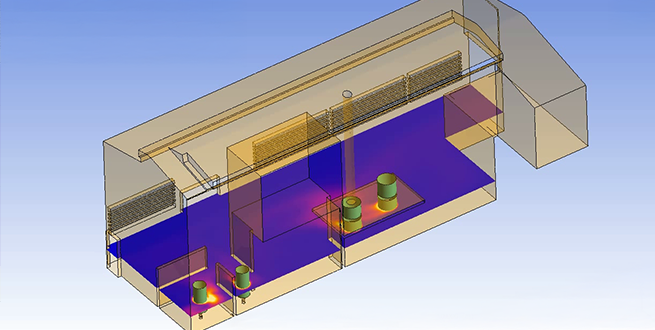
To prevent the building from becoming an unhealthy environment and without resorting to outdated calculation methods, Criteq integrated Ansys simulation tools into the project. The team modeled the thermal behavior of the warehouse to evaluate the airflow and validate whether the infrastructure would meet occupational comfort standards prior to construction.
Problem: Risk of thermal stress in a closed manufacturing warehouse, generated by the combination of reactors at 100°C and strong solar incidence on the roof.
Solution: Fluid-thermal virtual prototyping in CFD integrating regional wind data, the building’s 3D geometry, and the machinery’s thermal inventory.
Benefits: Guarantee of occupational thermal comfort, optimization of the initial investment (CAPEX) in ventilation, and elimination of post-construction corrective renovations.
Frequently Asked Questions (FAQ)
- How did Ansys simulation reduce the construction costs of the new chemical plant? The analysis in the Ansys Fluent® software proved that the natural wind flow entering through strategically positioned doors and windows was sufficient to cool the environment. This eliminated the purchase and installation of high-power motorized exhaust systems, reducing the initial investment in infrastructure (CAPEX).
- Which Ansys software was applied in Criteq’s thermal study? The team used the Ansys SpaceClaim® software and the Ansys Discovery™ application for 3D geometry modeling and simplification, and the Ansys Fluent® software for computational fluid dynamics (CFD) and heat transfer simulations.
- Is it possible to predict the thermal comfort of an industrial warehouse before construction? Yes. CFD simulation allows integrating data on solar radiation, external air speed, and heat emission from internal equipment to generate three-dimensional maps of temperature and air circulation before the construction is completed.